COR 1 Instrument
MOVIE GALLERY
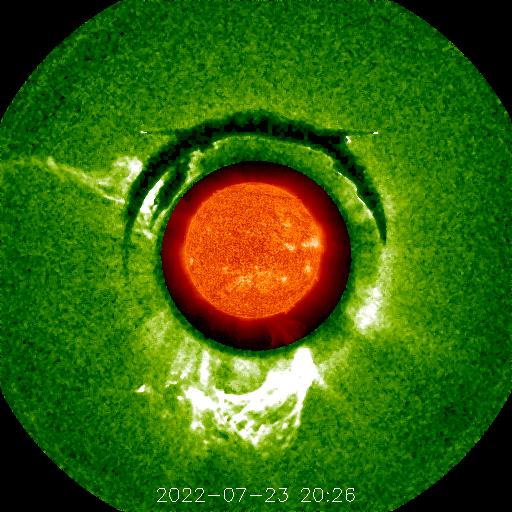
- Spectacular prominence eruption - 2022-07-23
Spectacular prominence eruption seen by the STEREO Ahead spacecraft on 23 July 2022. This eruption was on the far side of the Sun, and did not impact either STEREO Ahead or Earth.
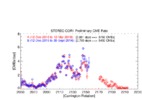
- COR1 Preliminary CME Rate Plot
CME rate plot for both STEREO A and B counts/day (duty-cycle corrected) vs carrington rotation thru 2019-03 (A) and 2014-09 (B).
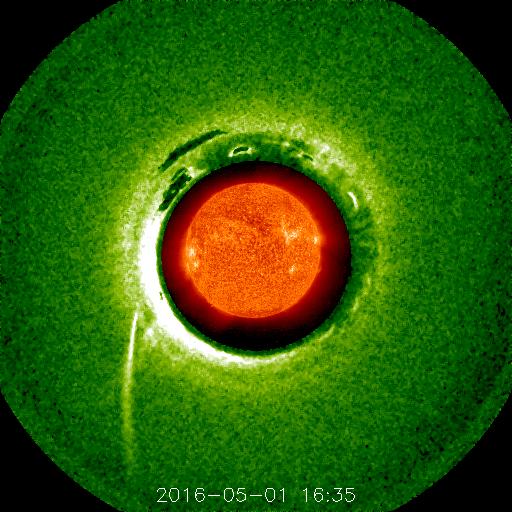
- Sungrazing Comet observed by COR 1 - 2016-05-01
Sungrazing Comet observed by COR 1 - 2016-05-01
- Proton Storm Surge
A far-side powerful flare erupted and triggered a huge and long-lasting proton storm that flew past the STEREO Behind spacecraft on Labor Day, Sept. 1, 2014. The storm was so strong that it temporarily confused the star trackers on both STEREO spacecraft. The "snowstorm effect" that you see was caused by high-energy particles hitting the spacecraft's detectors in the SECCHI instrument's extreme ultraviolet and inner coronagraph telescopes (EUVI and COR1). The moment when the star tracker on Behind resets is evident when the spacecraft starts rolling. The spacecraft uses SECCHI's guide telescope to keep locked on the Sun, but depends on the star tracker to determine its roll angle. Once the star tracker came back online, the spacecraft almost immediately moved back to its correct orientation. Credit: STEREO/NASA.
- Magnificent Blast
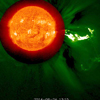
STEREO (Behind) captured this magnificent coronal mass ejection (associated with an M-class flare) that flung a long stream of plasma into space (Aug. 24, 2014). We have combined a view of the Sun in extreme UV light with a broader visible light view of the Sun's corona. It is interesting to note that a lot of the plasma, lacking sufficient kinetic energy to break free from the Sun's gravity, was pulled back into the Sun. Credit: STEREO/NASA.
- A very active Sun
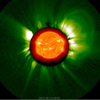
Three powerful X-class flares were released by active region AR1748 during just 24 hours between May 13-14, 2013, followed up by yet another X-class flare on May 15 (not shown). This movie, from the STEREO Behind observatory, located on the far side of the Sun, shows not only the three X-flares (seen as brief flahses) and their associated coronal mass ejections, but also quite a bit of other activity on the side of the Sun not visible from Earth. The active region producing the flares is near the upper-right edge of the Sun as seen in by STEREO Behind in the 304 Angstrom line of Helium (orange) by the EUVI telescope. Surrounding the Sun is the solar atmosphere revealed by another instrument, STEREO's COR1 coronagraph.
- Massive solar storm pointed straight at STEREO Behind
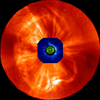
Like looking down the barrel of a cannon, the STEREO Behind spacecraft caught the Sun throwing a massive coronal mass ejection (CME) directly at it on March 5, 2013. Here are two movies showing the event as seen in the emission line at 195 Angstroms of highly ionized iron by the Extreme Ultraviolet Imager (EUVI, green), and in scattered white light by the inner (COR1, blue) and outer (COR2, red) coronagraphs. The event starts with a strong flare right in the active region right in the center of the Sun as seen from STEREO Behind, but which was hidden behind the limb for Earth-based telescopes. The associated CME then is seen as a halo around the Sun passing through the COR1 and COR2 fields of view, reaching the spacecraft itself two days later on March 7, where it was seen by the in situ particle and magnetic field instruments. While this solar blast was not pointed at Earth, it did include the planet Mars in its path. This prompted NASA to place the Curiosity rover on Mars in standby mode to wait out the storm.
- Massive prominence eruption seen by STEREO Ahead
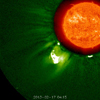
A massive prominence is shown erupting in this movie made of combined EUVI and COR1 images from the STEREO Ahead spacecraft. In orange is the Sun as seen in the emission line of helium at 304 Angstroms. Prominences emit strongly at this wavelength, and are clearly visible at various locations around the rim, in particular the massive one in the lower-left limb at the start of the movie. At higher heights above the limb, images taken by the COR1 inner coronagraph are shown in green. At the beginning of the movie, a small but rapid eruption can be seen near the top. This eruption may have been the final trigger for the eruption of the eruption of the prominence, which was close to erupting in any case.
- Unfurling Prominence
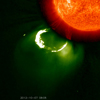
A large prominence swirled and twisted above the Sun's surface before breaking away and launching itself into space (Oct. 6-7, 2012). This image and movie are a combination of the Sun itself, observed in extreme UV light (from the STEREO Ahead spacecraft) and STEREO's view of the corona in white light taken by its COR1 instrument. Prominences are clouds of cooler plasma that hover above the Sun, tethered by unstable magnetic forces, which often break away or fade within days or weeks. The movie covers one day of activity.
- Going the Distance
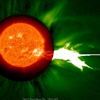
A very large and bright prominence erupted off the surface of the Sun around 19:00 UT on August 31, 2012 and just kept going. This video from the STEREO Behind spacecraft shows the prominence and the coronal mass ejection (CME) in which its is embedded as it leaves the Sun (orange, EUVI) and travels through the fields of view of COR1 (green), COR2 (red), and HI1 (blue) telescopes before it finally disappears from HI1 around the end of September 2, still clearly visible more than two days after it erupted. While CMEs are routinely seen in the Heliographic Imager (HI) telescopes, it's very rare for prominences to stay visible for so long. The HI1 field of view ranges from 4 to 24 degrees away from the Sun. To get a sense of scale, we know the Sun is roughly 860,000 miles wide-and look how far the prominence holds together. And this CME is so bright, it initially saturates the COR1 telescope.
Also visible in the movie is the planet Venus, which appears as a bright spot on the right side of the COR2 field. Venus is extremely bright and its image is saturated on the COR2 detector. It also creates a couple of artifacts in the movie due to internal reflections within the HI1 telescope. The first of these artifacts is a loop-like feature near the position of the planet on the left side of the HI1 field. The second is a large bubble-like feature on the opposite side of the HI1 image--this is more easily seen at the start of the movie. Both of these artifacts are explained on our website at http://stereo.gsfc.nasa.gov/artifacts/artifacts_reflections.shtml
- Filament Blowout
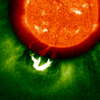
- A long filament erupted into space as seen by STEREO's Ahead spacecraft (Apr. 22, 2012). This shows a combination of the Sun taken in extreme UV light superimposed on the Sun's corona (seen in green). Filaments are elongated clouds of cooler gases suspended above the Sun by magnetic forces. They are often unstable and erupt. The video covers 11 hours of activity.
- Two massive prominence eruptions
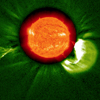
- Two massive prominence eruptions happen one right after the other on opposite sides of the Sun, as seen by the STEREO Ahead spacecraft in this movie. The prominences are first seen lifted off from the Sun in the Helium II emission line at 304 Angstroms by the EUVI telescope (orange), and then followed out to several solar radii by the COR1 coronagraph (green).
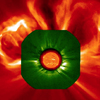
- Triple Solar Eruption
- Three Coronal Mass Ejections (CMEs) observed with NASA's STEREO Ahead Spacecraft on April 5-6, 2012. The center image shows an extreme ultraviolet image of the Sun. The green and red portions of the field of view show data from STEREO-A's two visible light coronagraphs.
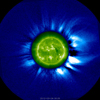
- CME 2012-03-24
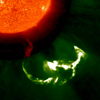
- Beautiful Solar Eruption, STEREO-B 2012-03-12
- A closeup view of a beautiful solar eruption shooting out into space as seen by NASA's STEREO-B on March 12, 2012. The orange image is of extreme ultraviolet light, while the part of the image in green is from a different STEREO telescope showing visible light beyond the edge of the solar disk.
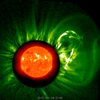
- Ka-Booooom!
- By combining observations from several instruments, we can see an initial solar eruption and the ensuing, large cloud of particles that blasted into space over a 10-hour period (Feb. 9-10, 2012). A close look at the orangish-sun image in extreme UV light shows a filament that broke away from the Sun to the right. This event was associated with a bright coronal mass ejection (CME) starting around 18 UT as seen by the STEREO Behind spacecraft. This eruption also occurred in conjunction with a B3.7 flare (fairly small). One combination of observations shows just the Sun in extreme UV light superimposed on the COR1 coronagraph (green). The other image set adds the more extensive field of view that is seen by COR2 at the same time. This video covers 17 hours of activity.
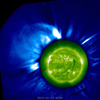
- Double Solar Eruption heads for Earth
- The STEREO Ahead spacecraft caught two back-to-back solar eruptions aimed at Earth on January 23, 2012. This movie shows both the first solar eruption, followed soon after by a bigger faster eruption and associated flare, as seen by the EUVI telescope in the hot Iron emission line at 195 Angstroms (green), and by the COR1 coronagraph in visible light (blue). Also visible are the arching post-flares loops above the solar limb at the end of the movie. The interaction between the two eruptions, as the second faster one plows into the first slower one, was responsible for a large particle storm at Earth for several days following the eruption. The eruptions themselves reached Earth two days later on January 24, creating beautiful auroral displays.
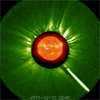
- Comet Lovejoy as captured by COR1 on STEREO Behind
- Here we see the sungrazing comet known as Comet Lovejoy as it races in for its close encounter with the Sun on 15 December 2011, and as it miraculously comes back out again the next day. The long bright tail is thrown out by the solar wind at closest approach, and only the coma is initially visible after it re-emerges from behind the COR1 occulter. However, toward the end of the movie one can see the tail starting to reform.
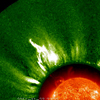
- Prominence Break-up
- A very long prominence arched up in its middle section, then broke into two, and both parts erupted into space (Nov. 22-23, 2011) as STEREO (Ahead) observed the action. The prominence had been in the view of SDO for about two weeks before it finally became unstable. The image shows the Sun (red) in extreme UV light superimposed on a coronagraph (green), in which the Sun is blocked by an occulting disk to reveal features in the corona. Prominences are clouds of cooler gases that are suspended above the Sun by magnetic forces. A close-up video of this eruption as observed by SDO can be viewed here: http://sdo.gsfc.nasa.gov/gallery/potw.php?v=item&id=76
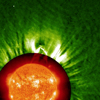
- Double Prominence Eruption
- A pair of prominence eruptions occurring on November 4 and 5, as seen by the STEREO Behind spacecraft. The associated coronal mass ejection was at too high a latitude to affect Earth.
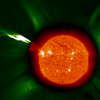
- Flare, CME, and Prominence Eruption
- Between August 2 to August 4, active region number 11261 produced a number of strong X-ray flares and associated coronal mass ejections (CMEs) toward Earth. These CMEs produced strong magnetic storms when they reached Earth. The most spectacular of these events occurred on August 4, when a particularly strong flare erupted. This flare was classified as M9.3, just below the X classification range used for the strongest flares. Particularly impressive is the large erupting prominence thrown out along with the CME, most of which is seen draining back down towards the end of the eruption. A smaller eruption, on the far side of the Sun (right side of the image) may be triggered by the first stronger eruption.
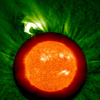
- Somersaulting CME
- On May 30, 2011, the STEREO Behind spacecraft caught a prominence in the process of leaping from one part of the Sun to another. In this movie, combining images from the EUVI and COR1 telescopes, the prominence is first seen erupting by EUVI in images taken in the Helium II emission line at 304 Angstroms. At higher elevations, it is seen in white light by the COR1 telescope. In the COR1 images, the prominence pauses. Some of the prominence material drains back down, but most of it is deflected to the north, and ends up raining down on a completely different part of the Sun, far from where it started. This is very unusual behavior for an erupting prominence, and this event is sure to be carefully studied by scientists. Some out-of-focus dust particles just in front of the COR1 telescope are briefly visible toward the end of the movie.
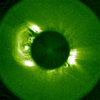
- CME and Comet
- A particularly beautiful coronal mass ejection (CME) was observed by the STEREO-Behind COR1 telescope on 11 May 2011. But as an added bonus, a bright sungrazing comet is seen flying in just after the CME. Coronal mass ejections are fairly common occurrences. Sungrazing comets are rarer, but still not uncommon. It's also not so unusual to see CMEs in conjunction with comets, leading some to wonder whether there could be a connection. The prevailing view among scientists is that there is no connection, and the apparent conjunction of the two is just a reflection of how common CMEs are. In this example, it's clear that the CME starts well before the comet reaches the Sun, and thus the CME could not possibly be caused by the comet. Like most sungrazing comets, it is only seen going in, and never comes out--it is destroyed when it gets too close to the Sun.
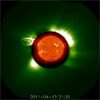
- Prominence 2011-04-13
- A prominence as seen by the COR 1 b and EUVI 304 instruments on 2011-04-13.
- CME and Particle Storm
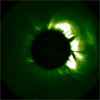
- Sometimes the Sun can reach out and directly affect the very telescopes used to observe it. This movie, from the COR1 telescope on STEREO-Ahead, shows a large coronal mass ejection (CME) erupting off of the Sun, followed by a veritable storm of cosmic ray events on the detector. The shock front from the CME accelerates particles to speeds close to the speed of light. The CME itself would take hours to days to cover the distance to STEREO, and is in any case traveling off to the side. However, the extremely fast particles accelerated by the CME take only minutes to cover the same distance. They are also deflected by the Sun's magnetic field, which carries them right to STEREO-Ahead. The black circle in the middle of the image is the occulter used to block out direct light from the Sun, allowing the much fainter light from the corona to be seen. Note how the cosmic ray streaks appear even inside the occulter shadow. This is because the high energy particles affecting the detector are coming in from the side, passing right through the instrument walls. Although the STEREO-Ahead spacecraft sees the CME clearly, the region producing the CME is actually on the far-side of the Sun from Earth, which is unaffected by the event.
- Coronal Mass Ejection, followed by Express Train
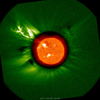
- Two strong X-ray flares were seen on the Earthward facing side of the Sun on Monday, March 7, 2011. The associated coronal mass ejections (CMEs) were well observed by STEREO. In this movie, made by the EUVI and COR1 telescopes on STEREO-Ahead, Earth is to the left of the picture. The first CME seen in the movie is associated with a class M1.7 that happens in an active on the other side of the Sun from STEREO-Ahead (but well observed by STEREO-Behind), and we can see a nice CME going out at a brisk pace of about 800 kilometers per second. But that's just the warm up, because a few hours later the large active region on the side of the Sun facing STEREO-Ahead produces a class M3.7 flare with an associated CME clocked at a whopping 2200 kilometers per second. In fact, the CME itself is so fast its front shell quickly passes through the COR1 field-of-view, and is followed by a beautiful erupting prominence.
- Triple Play
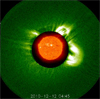
- If you look closely, you can see three CMEs coming out one after the other in this movie combining images from the EUVI and COR1 telescopes from the STEREO-Behind spacecraft. The first CME comes out at the 4 o'clock position, closely followed by another (with an erupting prominence) at about 1 o'clock. A broad, faint CME soon follows spread across the south pole. Even though they're all closely space in time, all three events come from different parts of the Sun.
- Prominence eruption, October 1, 2010
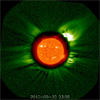
- Between September 30 and October 1, 2010, the STEREO EUVI and COR1 telescopes recorded a spectacular prominence eruption on the back side of the Sun. Here is the combined view as seen from STEREO Ahead.
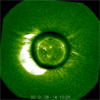
- CME event from August 14, 2010
- This is a movie of the CME on Aug 14 as seen from the STEREO Ahead EUVI and COR1 telescopes. The event is clearly visible first at 195 Angstroms by EUVI, and then follows out into the COR1 field of view. This is a halo event, and we should expect to see effects of the magnetic cloud in the STEREO Ahead in situ instruments within the next few days.
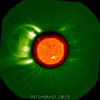
- Fast CME and prominence eruption
- One of the fastest CMEs in years was captured by the STEREO COR1 telescopes on August 1, 2010. This movie, combining COR1-Ahead images with the simultaneous Helium II 304 Angstrom images from the STEREO EUVI telescope, shows the rapid explosion of material outward, followed by a slower eruption of a polar crown prominence from another part of the Sun. This CME is seen to be heading towards Earth at speeds well over 1000 kilometers per second.
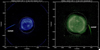
- STEREO spacecraft catch comet diving into Sun
- Using instruments aboard NASA's twin STEREO spacecraft, four post-doctoral fellows at UC Berkeley's Space Sciences Laboratory were able to track the comet as it approached the Sun (Mar. 11-12, 2010) and estimate an approximate time and place of impact. They then looked at data from the ground-based Mauna Loa Solar Observatory in Hawaii and found images in the predicted spot of what appears to be a comet approaching the limb of the Sun from behind the solar disk.
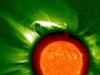
- Massive prominence eruption
- A massive prominence erupted from the Sun on April 13, 2010. The best view of the eruption was from the STEREO Ahead spacecraft, as shown in this COR1 movie, combined with Helium II 304 Angstrom images of the solar disk from EUVI. This was one of the largest prominence eruptions seen during the STEREO mission so far.
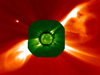
- Double whammy
- Two simultaneous CMEs are seen erupting in opposite directions in this movie combining images from the EUVI, COR1, and COR2 telescopes from the STEREO Ahead spacecraft on March 30, 2010. Also visible is the planet Mercury moving from right to left.
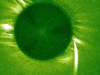
- Sungrazing comet observed by COR1-A
- Sungrazing comet observed by COR1-A on March 12, 2010. Note the faint tail remnant drifting away after perihelion.
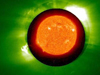
- Prominence eruption observed by COR1-B
- Prominence eruption observed by COR1-B on March 14, 2010. Also shown are the EUVI-B images in Helium II emission at 304 Angstroms.
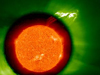
- Prominence eruption in the EUVI and COR1 telescopes - March 1, 2010
- This movie shows the prominence lifting off the limb first as seen in Helium II 304 A light in the EUVI images, and then continues as seen in the hydrogen H-alpha emission line in COR1.
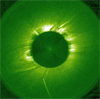
- Sungrazing comet
- Sungrazing comet observed by COR1-Ahead on January 21, 2010.
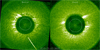
- A Comet seen by COR1
- A Comet seen by COR1
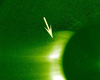
- This movie shows the planet Mercury crossing in front of the solar corona on October 27, 2007, as seen by the COR1 telescope on the STEREO Ahead spacecraft. This is known as a planetary transit. Mercury is so small that this event was not initially noticed in the data, and was only discovered when an analysis was done of the STEREO and planetary orbits looking for possible transit events.
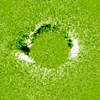
- Halo CME observed by COR1-B
- Most coronal mass ejections (CMEs) observed by the COR1 telescopes are seen to be traveling outside on one side or the other of the Sun. However, if a CME happens to be traveling directly toward (or in this case away from) the telescope, it will appear on all sides of the Sun at once. Such events are called halo CMEs, because they form a halo around the Sun. Just such an event was seen by the COR1 telescope on the STEREO Behind spacecraft on 15 November 2009.
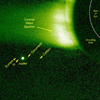
- Jupiter and Galilean moons observed
- No one has been able to observe Jupiter and its moons for some time as it is too close to the Sun, but that did not stop the STEREO (Behind) COR1 coronagraph from capturing it and its four major moons over a 30-hour period (March 15-16, 2009). If you look carefully, you can identify three of its moons close to Jupiter, and even discern how their positions change as the movie progresses. Those with keen eyes can see the fourth moon, Callisto, as a fainter object well to the right of the others. These four moons are known as the Galilean moons, because they were first discovered by Galileo Galilei in 1610. Jupiter itself is largely saturated in the movie, to bring out the moons and the faint solar corona. The solid dark green area on the right is the coronagraph?s occulting disk that blocks out the Sun and some of its bright atmosphere to that our instrument can see fainter structure just beyond the Sun. The thin, white line inside of that indicates the actual size of the Sun. By coincidence, a coronal mass ejection is seen blasting a white cloud of charged particles out into space during much of the clip. We have not seen many solar storms of late as the Sun is near its low point in its solar activity cycle.
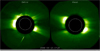
- Bright sungrazing comet observed by COR1 on May 23, 2008
- An extremely bright sungrazing comet was seen by COR1 on May 23, 2008 on both Ahead and Behind. Because of the separation of the two spacecraft, the comet appears quite differently in each. This is the brightest comet yet seen by COR1. The comet does not survive its approach to the Sun, and is not seen to come back out.
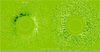
- Sungrazing comet observed by COR1 on June 16, 2008
- A sungrazing comet is seen by COR1 as it approaches the Sun and is destroyed. This movie is shown in the "running difference" format, where each image has an earlier image subtracted from it, to make the faint comet stand out from the much brighter solar corona. This makes it appear as if the comet is followed by its shadow, which is actually the negative image of the comet 20 minutes earlier. Because the two STEREO spacecraft are looking at the Sun from different directions, the appearance of the comet is quite different in each. The comet appears first coming up from below in the Behind view. Later, it is seen in Ahead approaching from the right. Combining these two viewpoints give us a three-dimensional view of the comet tail.
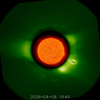
- Prominence Eruption on April 9, 2008
- It is a combination of COR1A and SECCHI EUVI 304 Angstrom images showing a spectacular prominence eruption on 2008-04-09. This event was also seen by the Hinode soft X-ray imager, and joint analysis of this interesting event is underway.
- Jupiter System Spotted by COR 1 - November 29, 2007
- Jupiter entered the field of view of the COR1 telescope on the STEREO Ahead spacecraft on November 29th, 2007. Along with the planet itself, one can clearly make out some of the major Jovian moons. The first moons to enter the COR1 field are Ganymede and Callisto, which start out very close to each other. These are followed closely by Jupiter itself, which is heavily saturated in the COR1 images. As time progresses, and the moons revolve about Jupiter, Ganymede and Callisto separate from each other, and become visible as separate moons. One also sees Io and Europa come out from in front of Jupiter, so that there's a period when all four major moons are visible. Io is the hardest of the four moons to see, because it spends much of its time very close to Europa. The feature on the right side of the movie is the occulter which is used to block out the bright sunlight.
- CME - August 1, 2007
- A CME appears in the NE on August 1, 2007, as seen by EUVI and COR1. The image processing software that produced this movie and some others in the Gallery is "Festival" which is available at: https://www.ias.u-psud.fr/stereo/festival
- Lunar Transit
- Combined data from EUVI and COR1 showing the lunar transit on 02/24/2007
- CME on February 9, 2007
- CME on February 9, 2007
- CME on February 9, 2007
- CME on February 9, 2007
- CME on February 9, 2007
- CME on February 9, 2007
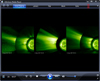
- A CME seen by STEREO A & B and SOHO
- This movie show a CME lifting off the East limb as seen simultaneously by STEREOB (left), SOHO (center) and STEREOA (right).
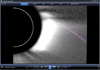
- Sungrazer Comet in 3D
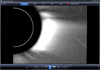
- The measured 3D position of the comet tail is overplotted in anaglyph format. Use red-blue glasses to see the effect.
- Sungrazer Comet Approaching the Sun
- This movie shows a sungrazer comet approaching the Sun as seen by the COR1 Ahead telescope on June 8, 2007. The comet was seen by both the STEREO Ahead and Behind spacecraft, allowing the position and shape of the comet tail to be measured in three dimensions.
- An unusual event observed by STEREO
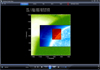
- Here is an unusual event observed by STEREO on May 1, 2007, off the northeast limb of the Sun. There was the "tornadic" motion of the prominence seen in Helium II (304 Angstrom); then what can only be described as a "blob" moved extremely slowly (<10 km/s) through the low corona, with non-radial motions through the MLSO MK4 and COR1. The "blob" seemed to "evaporate" at the trailing portion of what appeared to be an elongated fluxrope CME without any clear front. More study necessary to explain this one!
- Wavelet-enhanced images
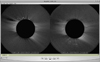
- Wavelet-enhanced images from May 2007, taken every six hours from COR1-A and COR1-B.
- June 2007 from COR1-A
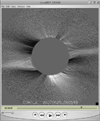
- Assembled and image-processed using a wavelet enhancement technique by Dr. Guillermo Stenborg. The frames are four images per day for the month of June 2007 from COR1-A.
- Halo CME
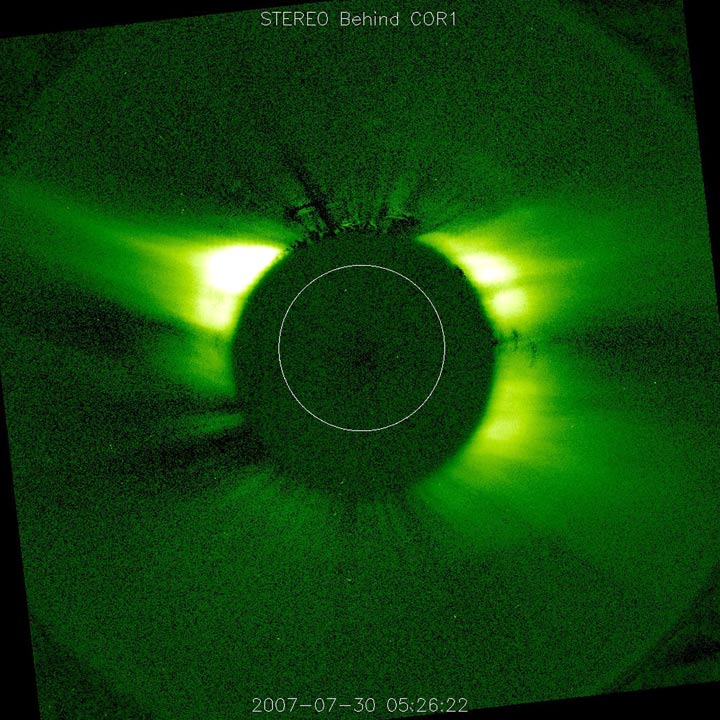
- The COR1 coronagraph instrument on STEREO caught a nice "halo" CME (coronal mass ejection) as it expanded out into space on July 30, 2007. It is named "halo" CME when the leading edge of the particle cloud appears as an expanding arc around the Sun, something we can see, though faintly, in this video. The ejected material is either heading more or less directly towards or away from the viewer. In this case, the event was judged to have occurred on the backside of the Sun as we saw no evidence of an event on the front side. The video clip cover about 8 hours of activity.
- An apparent "halo" CME
- An apparent "halo" CME detected in Total Brightness on 20-May-2007
- TotalB Movie
- TotalB movie of a multipart CME(s) on the West limb on 22-May-2007
- COR1 detection of a CME off the SE limb
- COR1 detection of a CME off the SE limb on 08-July-2007. It was difficult to detect the leading edge of this event, but there was a strong "concave-out" trailing feature, remniscent of a flux rope morphology.
- A large CME off the northeast limb
- A large CME off the northeast limb of the Sun detected on May 15, 2007, by both COR1-A and -B.
- 2007-02-24 Lunar Transit
- 2007-02-24 The STEREO-B spacecraft was treated to a lunar transit of the solar disk. This is what the Moon looked like in the COR1 coronagraph as it headed toward the Sun and onward the following day.
- COR1-B North-East Quadrant showing CME
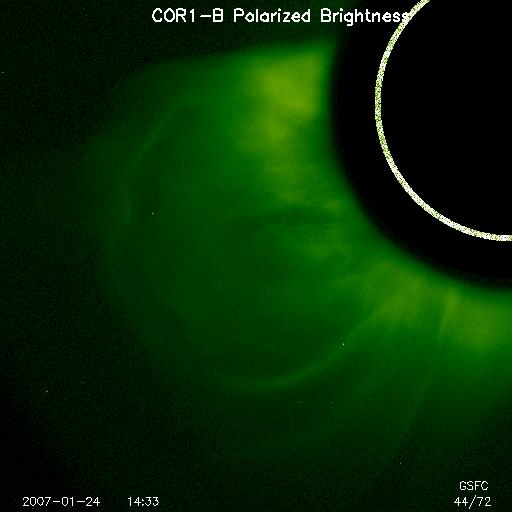
- 2007-01-24 COR1-B North-East Quadrant showing CME at full spatial resolution in polarized brightness (pB)
- CME in polarized brightness (pB)
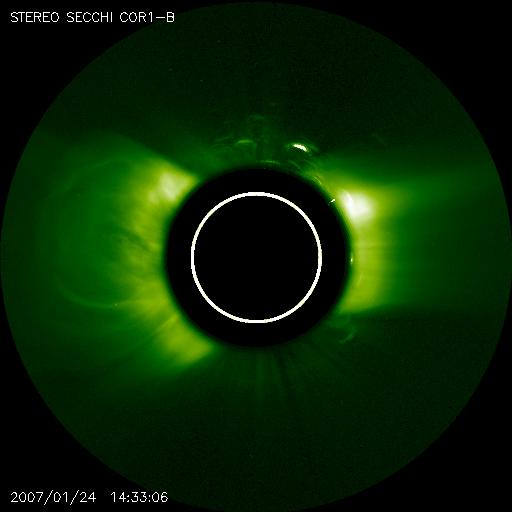
- 2007-01-24 COR1-B full-field images showing CME in polarized brightness (pB)
- Mercury Passage
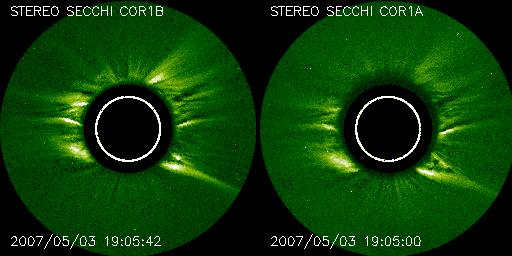
- 2007-05-03 COR1-A and COR1-B polarized brightness (pB) movies showing Mercury passage when spacecraft were separated by 6.3 degrees
- COR1-B North-East Quadrant showing CME
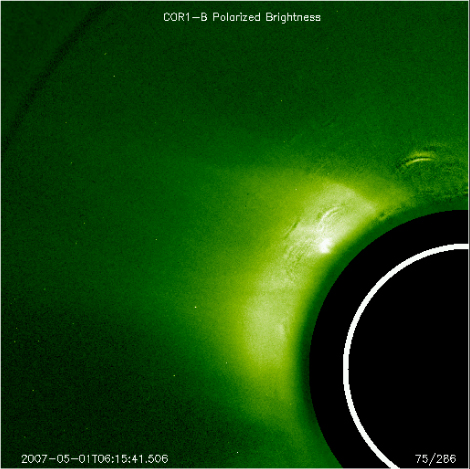
- 2007-05-01 COR1-B North-East Quadrant showing CME at full spatial resolution in polarized brightness (pB)
- Comparing various methods of studying CMEs
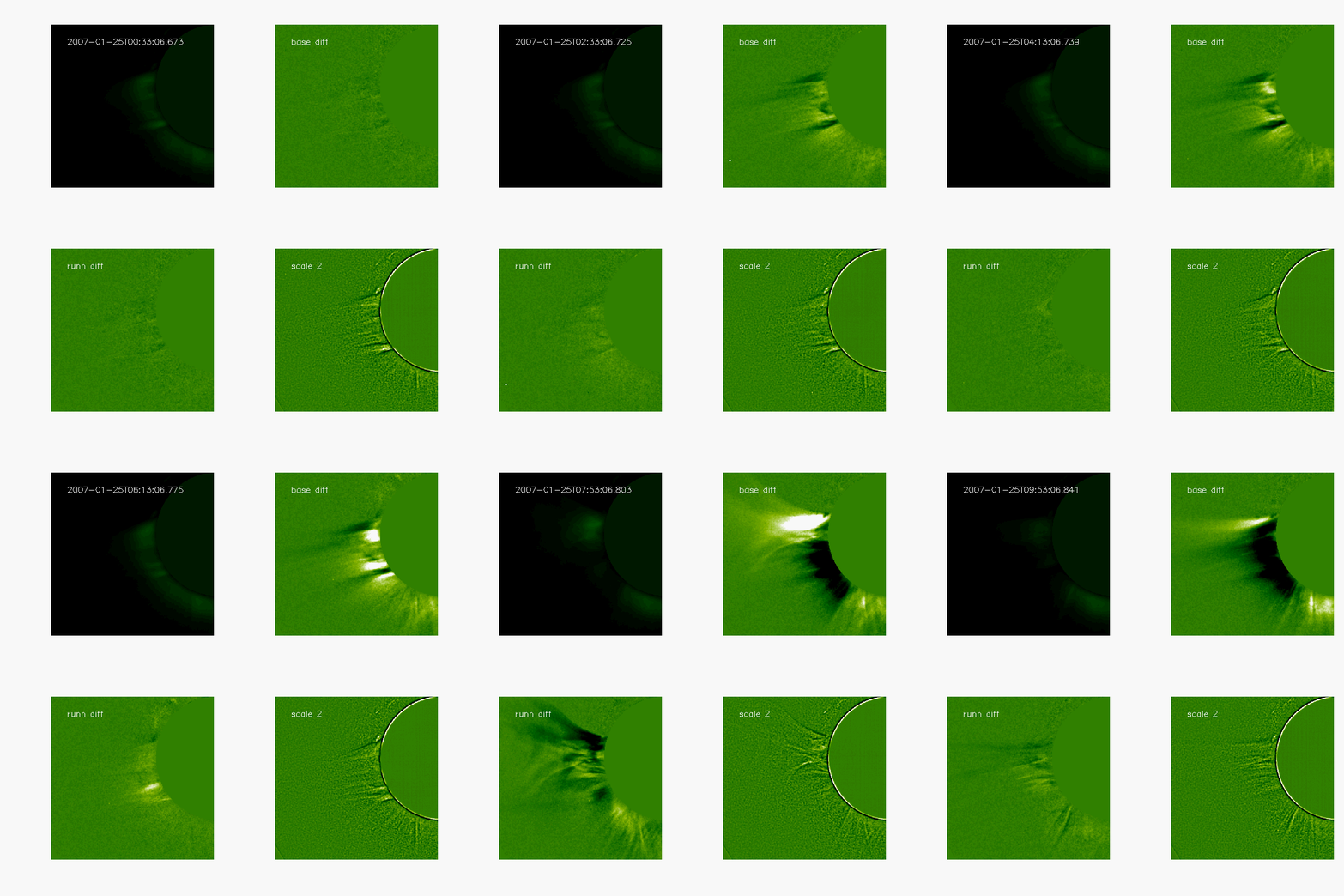
- A comparison of various methods of studying CMEs From top to bottom, left top right: the polarized brightness movie; the same data, but with the first frame used as a base difference; the same data, this time with the previous frame subtracted (running difference); the wavelet decomposed (atrous wavelet, scale 2) of the same data (25 January 2007, COR1-B).
- The multiscale canny decomposed data
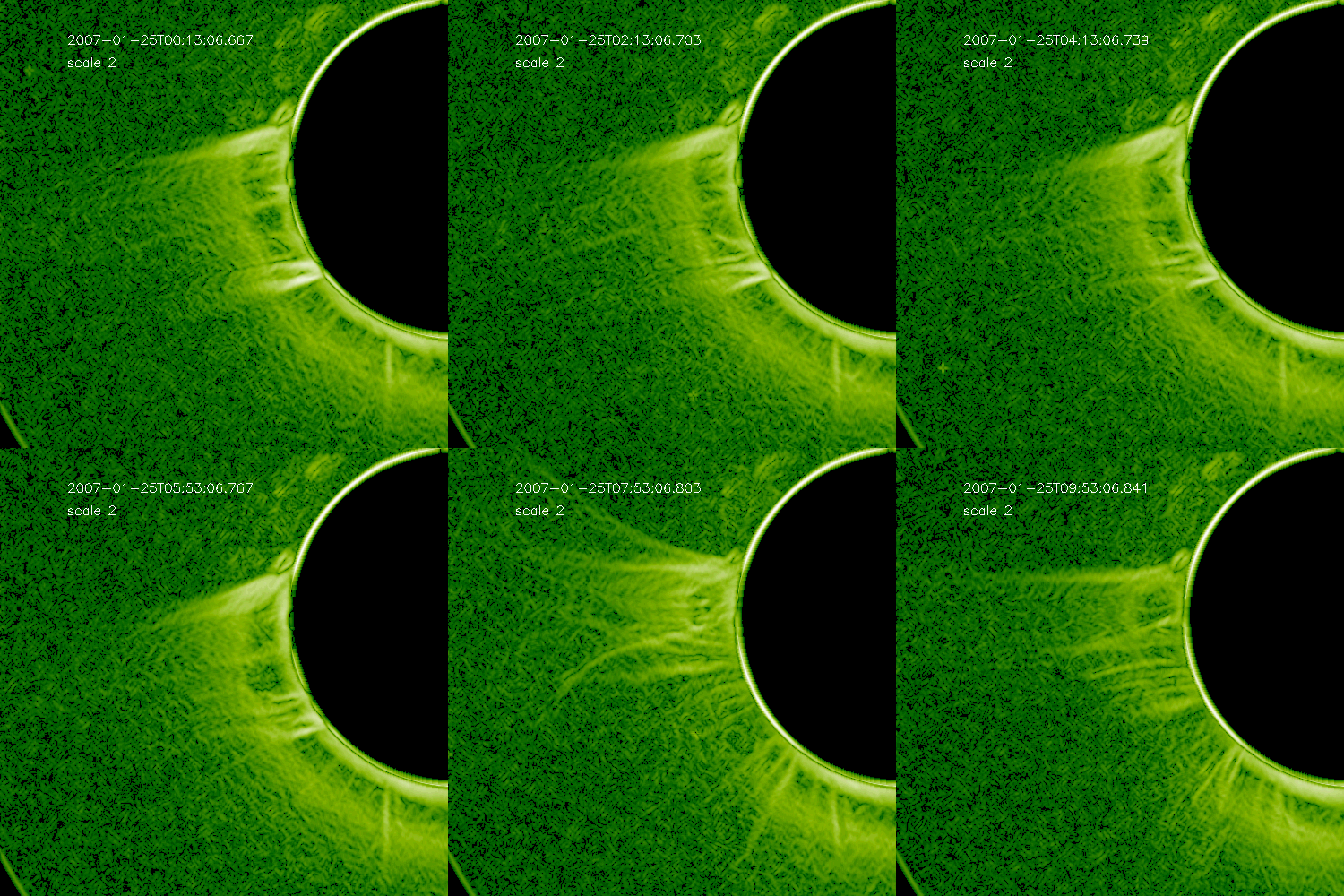
- The canny decomposition runs a 'Mexican hat' wavelet in each direction and then creates the modulus (plotted here) and the angle of maximum gradient (25 January 2007, COR1-B).

- Angle of maximum gradient
- Angle of maximum gradient, in degrees clockwise from pointing right (black): up is red; left is green; down is blue (25 January 2007, COR1-B).

- 2007-01-24 Polarized Brightness Images
- 2007-01-24 Polarized Brightness images from COR1-B (click on images for larger image)
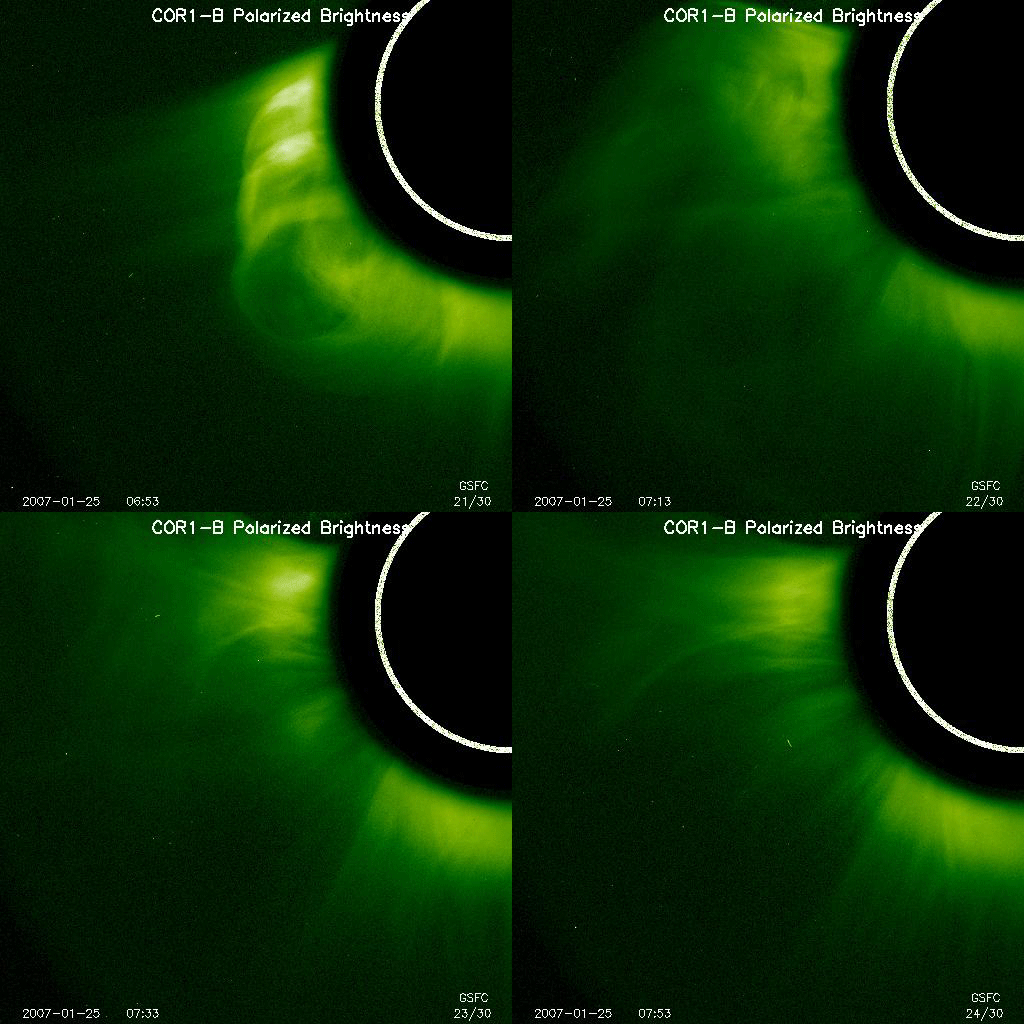
- 2007-01-25 Polarized Brightness Images
- 2007-01-25 Polarized Brightness images from COR1-B (click on images for larger image)


